Article: CCC 144-145 Explained — The Obedience of Faith and Abraham, Father of All Believers
CCC 144-145 Explained — The Obedience of Faith and Abraham, Father of All Believers
Catechism Article 1 — The Creed
I. The Obedience of Faith — CCC 144-145
When you read the Catechism on a printed page, a single paragraph sends you to a dozen other places: footnotes to Scripture, margin numbers to other paragraphs, references to Council documents. Almost nobody looks them all up, and the argument is lost.
Below, the Catechism is opened completely. Each paragraph, then every Bible verse it rests on in full, then every paragraph it cross-references in full, with their verses too. Nothing summarized, nothing to look up elsewhere. Let the verses explain themselves.
CCC 144
To obey (from the Latin ob-audire, to "hear or listen to") in faith is to submit freely to the word that has been heard, because its truth is guaranteed by God, who is Truth itself. Abraham is the model of such obedience offered us by Sacred Scripture. The Virgin Mary is its most perfect embodiment.
Cross-reference: CCC 1814
Faith is the theological virtue by which we believe in God and believe all that he has said and revealed to us, and that Holy Church proposes for our belief, because he is truth itself. By faith "man freely commits his entire self to God." For this reason the believer seeks to know and do God's will. "The righteous shall live by faith." Living faith "work[s] through charity."
The verses this paragraph rests on
Romans 1:17 — For the justice of God is revealed therein, from faith unto faith, as it is written: The just man liveth by faith.
Habacuc 2:4 — Behold, he that is unbelieving, his soul shall not be right in himself: but the just shall live in his faith.
Galatians 3:11 — But that in the law no man is justified with God, it is manifest: because the just man liveth by faith.
Acts of the Apostles 10:38 — Jesus of Nazareth: how God anointed him with the Holy Ghost, and with power, who went about doing good, and healing all that were oppressed by the devil, for God was with him.
Galatians 5:6 — For in Christ Jesus neither circumcision availeth any thing, nor uncircumcision: but faith that worketh by charity.
1 Corinthians 13:2 — And if I should have prophecy and should know all mysteries, and all knowledge, and if I should have all faith, so that I could remove mountains, and have not charity, I am nothing.
1 Corinthians 13:13 — And now there remain faith, hope, and charity, these three: but the greatest of these is charity.
Continues at CCC 506 — Mary's virginity as the sign of her undivided faith.
Cross-reference: CCC 1815
The gift of faith remains in one who has not sinned against it. But "faith apart from works is dead"; when it is deprived of hope and love, faith does not fully unite the believer to Christ and does not make him a living member of his Body.
The verses this paragraph rests on
Epistle of James 2:26 — For even as the body without the spirit is dead; so also faith without works is dead.
Genesis 2:7 — And the Lord God formed man of the slime of the earth: and breathed into his face the breath of life, and man became a living soul.
1 Kings 17:17 — And it came to pass after this that the son of the woman, the mistress of the house, fell sick, and the sickness was very grievous, so that there was no breath left in him.
1 Kings 17:18 — And she said to Elias: What have I to do with thee, thou man of God? art thou come to me that my iniquities should be remembered, and that thou shouldst kill my son?
1 Kings 17:19 — And Elias said to her: Give me thy son. And he took him out of her bosom, and carried him into the upper chamber where he abode, and laid him upon his own bed.
1 Kings 17:20 — And he cried to the Lord, and said: O Lord my God, hast thou afflicted also the widow, with whom I am after a sort maintained, so as to kill her son?
1 Kings 17:21 — And he stretched, and measured himself upon the child three times, and cried to the Lord, and said: Lord my God, let the soul of this child, I beseech thee, return into his body.
1 Kings 17:22 — And the Lord heard the voice of Elias: and the soul of the child returned into him, and he revived.
Psalms 102:23 — He answered him in the way of his strength: Declare unto me the fewness of my days.
Psalms 102:24 — Call me not away in the midst of my days: thy years are unto generation and generation.
Ecclesiastes 3:19 — Therefore the death of man, and of beasts is one, and the condition of them both is equal: as man dieth, so they also die: all things breathe alike, and man hath nothing more than beast: all things are subject to vanity.
Isaias 2:22 — Cease ye therefore from the man, whose breath is in his nostrils, for he is reputed high.
Daniel 5:23 — But hast lifted thyself up against the Lord of heaven: and the vessels of his house have been brought before thee: and thou, and thy nobles, and thy wives, and thy concubines have drunk wine in them: and thou hast praised the gods of silver, and of gold, and of brass, of iron, and of wood, and of stone, that neither see, nor hear, nor feel: but the God who hath thy breath in his hand, and all thy ways, thou hast not glorified.
Apocalypse (Revelation) 11:11 — And after three days and a half, the spirit of life from God entered into them. And they stood upon their feet, and great fear fell upon them that saw them.
Colossians 1:4 — Hearing your faith in Christ Jesus, and the love which you have towards all the saints.
1 Thessalonians 1:3 — Being mindful of the work of your faith, and labour, and charity, and of the enduring of the hope of our Lord Jesus Christ before God and our Father.
Epistle of James 2:18 — But some man will say: Thou hast faith, and I have works: shew me thy faith without works; and I will shew thee, by works, my faith.
Epistle of James 2:20 — But wilt thou know, O vain man, that faith without works is dead?
Epistle of James 2:22 — Seest thou, that faith did co-operate with his works; and by works faith was made perfect?
Cross-reference: CCC 1816
The disciple of Christ must not only keep the faith and live on it, but also profess it, confidently bear witness to it, and spread it: "All however must be prepared to confess Christ before men and to follow him along the way of the Cross, amidst the persecutions which the Church never lacks." Service of and witness to the faith are necessary for salvation: "So every one who acknowledges me before men, I also will acknowledge before my Father who is in heaven; but whoever denies me before men, I also will deny before my Father who is in heaven."
The verses this paragraph rests on
Matthew 10:32 — Every one therefore that shall confess me before men, I will also confess him before my Father who is in heaven.
Luke 12:8 — And I say to you, Whosoever shall confess me before men, him shall the Son of man also confess before the angels of God.
Apocalypse (Revelation) 3:5 — He that shall overcome, shall thus be clothed in white garments, and I will not blot out his name out of the book of life, and I will confess his name before my Father, and before his angels.
Matthew 10:33 — But he that shall deny me before men, I will also deny him before my Father who is in heaven.
Mark 8:38 — For he that shall be ashamed of me, and of my words, in this adulterous and sinful generation: the Son of man also will be ashamed of him, when he shall come in the glory of his Father with the holy angels.
Luke 9:26 — For he that shall be ashamed of me and of my words, of him the Son of man shall be ashamed, when he shall come in his majesty, and that of his Father, and of the holy angels.
Luke 12:9 — But he that shall deny me before men, shall be denied before the angels of God.
2 Timothy 2:12 — If we suffer, we shall also reign with him. If we deny him, he will also deny us.
Continues at CCC 2471 — bearing witness to the truth.
Abraham, the "Father of All Believers"
CCC 145
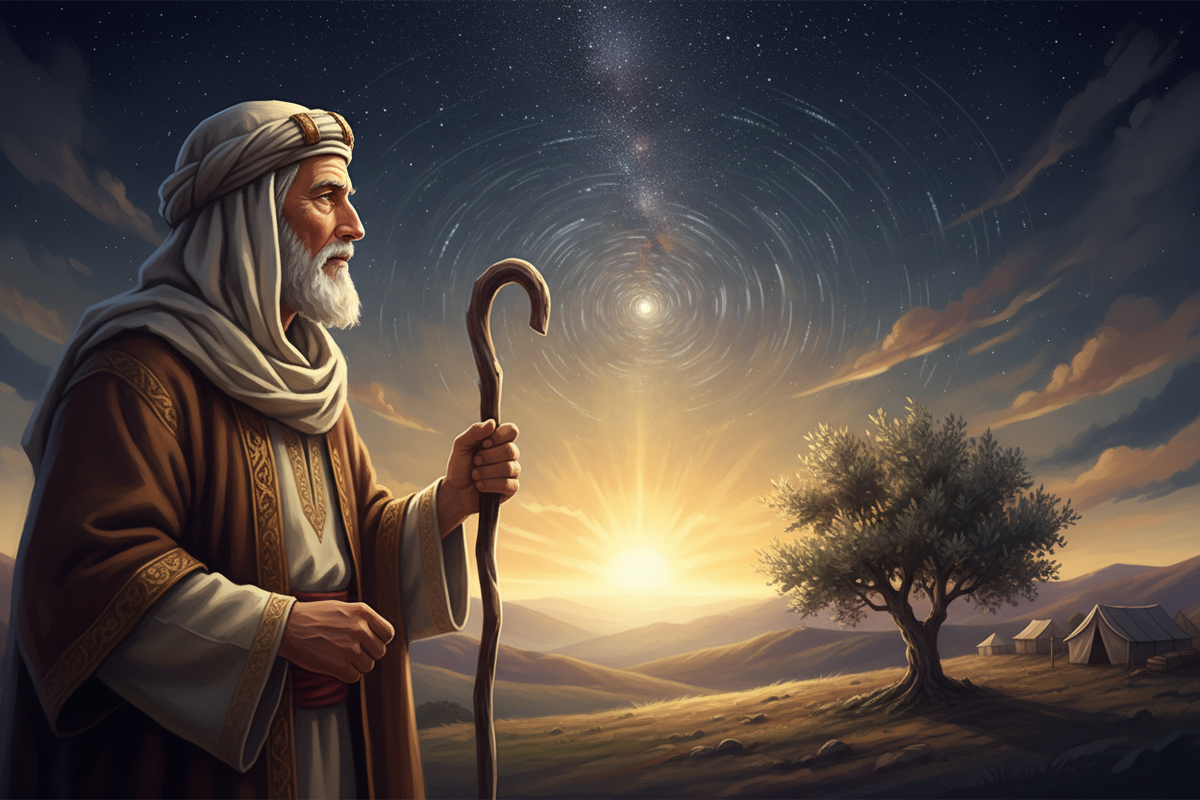
The Letter to the Hebrews, in its great eulogy of the faith of Israel's ancestors, lays special emphasis on Abraham's faith: "By faith, Abraham obeyed when he was called to go out to a place which he was to receive as an inheritance; and he went out, not knowing where he was to go." By faith, he lived as a stranger and pilgrim in the promised land. By faith, Sarah was given to conceive the son of the promise. And by faith Abraham offered his only son in sacrifice.
The verses this paragraph rests on
Hebrews 11:8 — By faith he that is called Abraham, obeyed to go out into a place which he was to receive for an inheritance; and he went out, not knowing whither he went.
Genesis 12:1 — And the Lord said to Abram: Go forth out of thy country, and from thy kindred, and out of thy father's house, and come into the land which I shall shew thee.
Genesis 12:2 — And I will make of thee a great nation, and I will bless thee, and magnify thy name, and thou shalt be blessed.
Genesis 12:3 — I will bless them that bless thee, and curse them that curse thee, and IN THEE shall all the kindred of the earth be blessed.
Genesis 12:4 — So Abram went out as the Lord had commanded him, and Lot went with him: Abram was seventy-five years old when he went forth from Haran.
Acts of the Apostles 7:3 — And said to him: Go forth out of thy country, and from thy kindred, and come into the land which I shall shew thee.
Genesis 26:4 — And I will multiply thy seed like the stars of heaven: and I will give to thy posterity all these countries: and in thy seed shall all the nations of the earth be blessed.
Galatians 3:8 — And the scripture, foreseeing, that God justifieth the Gentiles by faith, told unto Abraham before: In thee shall all nations be blessed.
Galatians 3:16 — To Abraham were the promises made and to his seed. He saith not, And to his seeds, as of many: but as of one, And to thy seed, which is Christ.
Genesis 23:4 — I am a stranger and sojourner among you: give me the right of a burying-place with you, that I may bury my dead.
Genesis 47:9 — He answered: The days of my pilgrimage are a hundred and thirty years, few, and evil, and they are not come up to the days of the pilgrimage of my fathers.
Psalms 39:12 — Hear my prayer, O Lord, and my supplication: give ear to my tears. Be not silent: for I am a stranger with thee, and a sojourner as all my fathers were.
Hebrews 11:13 — All these died according to faith, not having received the promises, but beholding them afar off, and saluting them, and confessing that they are pilgrims and strangers on the earth.
1 Peter 2:11 — Dearly beloved, I beseech you as strangers and pilgrims, to refrain yourselves from carnal desires which war against the soul.
Hebrews 11:17 — By faith Abraham, when he was tried, offered Isaac: and he that had received the promises, offered up his only begotten son.
Genesis 22:1 — After these things, God tempted Abraham, and said to him: Abraham, Abraham. And he answered: Here I am.
Genesis 22:2 — He said to him: Take thy only begotten son Isaac, whom thou lovest, and go into the land of vision: and there thou shalt offer him for a holocaust upon one of the mountains which I will show thee.
Genesis 22:3 — So Abraham rising up in the night, saddled his ass: and took with him two young men, and Isaac his son: and when he had cut wood for the holocaust he went his way to the place which God had commanded him.
Genesis 22:4 — And on the third day, lifting up his eyes, he saw the place afar off.
Genesis 22:5 — And he said to his young men: Stay you here with the ass: I and the boy will go with speed as far as yonder, and after we have worshipped, will return to you.
Genesis 22:6 — And he took the wood for the holocaust, and laid it upon Isaac his son: and he himself carried in his hands fire and a sword. And as they two went on together.
Genesis 22:7 — Isaac said to his father: My father. And he answered: What wilt thou, son? Behold, saith he, fire and wood: where is the victim for the holocaust?
Genesis 22:8 — And Abraham said: God will provide himself a victim for an holocaust, my son. So they went on together.
Genesis 22:9 — And they came to the place which God had shown him, where he built an altar, and laid the wood in order upon it: and when he had bound Isaac his son, he laid him on the altar upon the pile of wood.
Genesis 22:10 — And he put forth his hand and took the sword, to sacrifice his son.
Genesis 22:11 — And behold an angel of the Lord from heaven called to him, saying: Abraham, Abraham. And he answered: Here I am.
Genesis 22:12 — And he said to him: Lay not thy hand upon the boy, neither do thou any thing to him: now I know that thou fearest God, and hast not spared thy only begotten son for my sake.
Genesis 22:13 — Abraham lifted up his eyes, and saw behind his back a ram amongst the briers sticking fast by the horns, which he took and offered for a holocaust instead of his son.
Genesis 22:14 — And he called the name of that place, The Lord seeth. Whereupon even to this day it is said: In the mountain the Lord will see.
Genesis 22:15 — And the angel of the Lord called to Abraham a second time from heaven, saying.
Genesis 22:16 — By my own self have I sworn, saith the Lord: because thou hast done this thing, and hast not spared thy only begotten son for my sake.
Cross-reference: CCC 59
In order to gather together scattered humanity God calls Abram from his country, his kindred, and his father's house, and makes him Abraham, that is, "the father of a multitude of nations." "In you all the nations of the earth shall be blessed."
The verses this paragraph rests on
Genesis 17:5 — Neither shall thy name be called any more Abram: but thou shalt be called Abraham: because I have made thee a father of many nations.
Genesis 17:15 — God said also to Abraham: Sarai thy wife thou shalt not call Sarai, but Sara.
Genesis 32:28 — But he said: Thy name shall not be called Jacob, but Israel: for if thou hast been strong against God, how much more shalt thou prevail against men?
Nehemias 9:7 — Thou, O Lord God, art he who chosest Abram, and broughtest him forth out of the fire of the Chaldeans, and gavest him the name of Abraham.
John 1:42 — And he brought him to Jesus. And Jesus looking upon him, said: Thou art Simon the son of Jona: thou shalt be called Cephas, which is interpreted Peter.
Apocalypse (Revelation) 2:17 — He, that hath an ear, let him hear what the Spirit saith to the churches: To him that overcometh, I will give the hidden manna, and will give him a white counter, and in the counter, a new name written, which no man knoweth, but he that receiveth it.
Romans 4:17 — (As it is written: I have made thee a father of many nations,) before God, whom he believed, who quickeneth the dead; and calleth those things that are not, as those that are.
Galatians 3:8 — And the scripture, foreseeing, that God justifieth the Gentiles by faith, told unto Abraham before: In thee shall all nations be blessed.
Genesis 12:3 — I will bless them that bless thee, and curse them that curse thee, and IN THEE shall all the kindred of the earth be blessed.
Genesis 26:4 — And I will multiply thy seed like the stars of heaven: and I will give to thy posterity all these countries: and in thy seed shall all the nations of the earth be blessed.
Cross-reference: CCC 2570
When God calls him, Abraham goes forth "as the Lord had told him"; Abraham's heart is entirely submissive to the Word and so he obeys. Such attentiveness of the heart, whose decisions are made according to God's will, is essential to prayer, while the words used count only in relation to it. Abraham's prayer is expressed first by deeds: a man of silence, he constructs an altar to the Lord at each stage of his journey. Only later does Abraham's first prayer in words appear: a veiled complaint reminding God of his promises which seem unfulfilled. Thus one aspect of the drama of prayer appears from the beginning: the test of faith in the fidelity of God.
The verses this paragraph rests on
Genesis 15:2 — And Abram said: Lord God, what wilt thou give me? I shall go without children: and the son of the steward of my house is this Damascus Eliezer.
Genesis 15:3 — And Abram added: But to me thou hast not given seed: and lo my servant, born in my house, shall be my heir.
Cross-reference: CCC 489
Throughout the Old Covenant the mission of many holy women prepared for that of Mary. At the very beginning there was Eve; despite her disobedience, she receives the promise of a posterity that will be victorious over the evil one, as well as the promise that she will be the mother of all the living. By virtue of this promise, Sarah conceives a son in spite of her old age. Against all human expectation God chooses those who were considered powerless and weak to show forth his faithfulness to his promises: Hannah, the mother of Samuel; Deborah; Ruth; Judith and Esther; and many other women. Mary "stands out among the poor and humble of the Lord, who confidently hope for and receive salvation from him. After a long period of waiting the times are fulfilled in her, the exalted Daughter of Sion, and the new plan of salvation is established."
The verses this paragraph rests on
Judges 18:31 — And the idol of Michas remained with them all the time that the house of God was in Silo. In those days there was no king in Israel.
1 Samuel 1:6 — Her rival also afflicted her, and troubled her exceedingly, insomuch that she upbraided her, that the Lord had shut up her womb.
Genesis 16:1 — Now Sarai the wife of Abram, had brought forth no children; having a handmaid, an Egyptian, named Agar.
Genesis 11:30 — And Sarai was barren, and had no children.
Judges 13:2 — Now there was a certain man of Saraa, and of the race of Dan, whose name was Manue, and his wife was barren.
Matthew 1:7 — And Solomon begot Roboam. And Roboam begot Abia. And Abia begot Asa.
1 Samuel 1:11 — And she made a vow, saying: O Lord, of hosts, if thou wilt look down on the affliction of thy servant, and wilt be mindful of me, and not forget thy handmaid, and wilt give to thy servant a man child: I will give him to the Lord all the days of his life, and no razor shall come upon his head.
Numbers 6:5 — All the time of his separation no razor shall pass over his head, until the day be fulfilled of his consecration to the Lord. He shall be holy, and shall let the hair of his head grow.
Judges 13:5 — Because thou shalt conceive and bear a son, and no razor shall touch his head: for he shall be a Nazarite of God, from his infancy, and from his mother's womb, and he shall begin to deliver Israel from the hands of the Philistines.
1 Samuel 1:12 — And it came to pass, as she multiplied prayers before the Lord, that Heli observed her mouth.
1 Samuel 1:13 — Now Anna spoke in her heart, and only her lips moved, but her voice was not heard at all. Heli therefore thought her to be drunk.
1 Samuel 1:14 — And said to her: How long wilt thou be drunk? digest a little the wine, of which thou hast taken too much.
1 Samuel 1:15 — Anna answering, said: Not so, my lord: for I am an exceeding unhappy woman, and have drunk neither wine nor any strong drink, but I have poured out my soul before the Lord.
Psalms 62:8 — Trust in him, all ye congregation of people: pour out your hearts before him. God is our helper for ever.
Lamentations 2:19 — Coph. Arise, give praise in the night, in the beginning of the watches: pour out thy heart like water before the face of the Lord: lift up thy hands to him for the life of thy little children, that have fainted for hunger at the top of all the streets.
1 Samuel 1:16 — Count not thy handmaid for one of the daughters of Belial: for out of the abundance of my sorrow and grief have I spoken till now.
1 Samuel 1:17 — Then Heli said to her: Go in peace: and the God of Israel grant thee thy petition, which thou hast asked of him.
1 Samuel 1:18 — And she said: Would to God thy handmaid may find grace in thy eyes. So the woman went on her way, and ate, and her countenance was no more changed.
1 Samuel 1:19 — And they rose in the morning, and worshipped before the Lord: and they returned, and came into their house at Ramatha. And Elcana knew Anna his wife: and the Lord remembered her.
Genesis 21:1 — And the Lord visited Sara, as he had promised: and fulfilled what he had spoken.
Genesis 30:22 — The Lord also remembering Rachel, heard her, and opened her womb.
1 Samuel 1:20 — And it came to pass when the time was come about, Anna conceived and bore a son, and called his name Samuel: because she had asked him of the Lord.
Genesis 41:51 — And he called the name of the first born Manasses, saying: God hath made me to forget all my labours, and my father's house.
Genesis 41:52 — And he named the second Epharaim, saying: God hath made me to grow in the land of my poverty.
Exodus 2:10 — And she adopted him for a son, and called him Moses, saying: Because I took him out of the water.
Exodus 2:22 — And she bore him a son, whom he called Gersam, saying: I have been a stranger in a foreign country. And she bore another, whom he called Eliezer, saying: For the God of my father, my helper hath delivered me out of the hand of Pharao.
Matthew 1:21 — And she shall bring forth a son: and thou shalt call his name JESUS. For he shall save his people from their sins.
1 Samuel 1:21 — And Elcana her husband went up, and all his house, to offer to the Lord the solemn sacrifice, and his vow.
1 Samuel 1:22 — But Anna went not up: for she said to her husband: I will not go till the child be weaned, and till I may carry him, that he may appear before the Lord, and may abide always there.
Luke 2:22 — And after the days of her purification, according to the law of Moses, were accomplished, they carried him to Jerusalem, to present him to the Lord.
1 Samuel 1:23 — And Elcana her husband said to her: Do what seemeth good to thee, and stay till thou wean him: and I pray that the Lord may fulfil his word. So the woman stayed at home, and gave her son suck, till she weaned him.
1 Samuel 1:24 — And after she had weaned him, she carried him with her, with three calves, and three bushels of flour, and a bottle of wine, and she brought him to the house of the Lord in Silo.
Continues at CCC 722, CCC 410, CCC 145 and CCC 64 — the Holy Spirit's preparation of Mary, the promise of victory over the evil one, the faith of Abraham, and the prophets' hope of the New Covenant.
This is two paragraphs. Article 1 has twenty-two.
Article 1 of the Catechism, the Creed, runs from CCC 144 to CCC 165. What you just read is the complete expansion of the first two paragraphs alone: one chain of faith running from Abraham through Hannah to the Virgin Mary, every link written out.
Opened this way, the full Article runs to 387 pages: every paragraph, every verse, every cross-reference, every magisterial source, resolved on the page.
That complete study is our book The Creed — Biblical Exegesis, a verse-by-verse textual, magisterial and cross-reference study of Catholic dogma through the Douay-Rheims, the Latin Vulgate, and the Navarre Bible tradition.
New here? Read the Book of Proverbs free for 15 days. No credit card, no registration: start the free Proverbs reading.
Scripture quotations are from the Douay-Rheims. Every subscription supports the works of mercy carried out through the Centers of Mercy.
Based on 14 years of independent research. The only work of its kind in the world.
© 2026 Exegesis Biblica. All rights reserved.
“Please choose the subscription plan that best fits your needs. For Gold, Premium, Platinum, or Student Premium Plus, first request access using the link below and wait for approval before subscribing.
The Old Testament Library — Public is open to everyone and does not require authorization.”
Request 🥇 Gold ✝️ Clergy Access —Bible + Catechism (No Premium)$16.99/month Access →
Request ⭐ Premium — Full Library Including Premium $29.99/month Access →
Request 💎 Platinum — ✝️ Monks, Nuns, Friars & Non-Income Clergy $15.00/year Access →
Request 🎓 Student Premium Plus — OT Library $10.00/year Access →
📚 All Subscription Plans
Prices shown in USD. Your local price is applied automatically at checkout.
🥈 Old Testament Library — Public
$12.99/month
Access all currently available Old Testament books. One additional Old Testament book will be added every two months. Open to all — no authorization required.
Explore the Old Testament Library →
🥇 Gold ✝️ Clergy Access — Bible + Catechism (No Premium)
$16.99/month
All Old Testament + New Testament books, plus eligible non-Premium Catechism books — stackable. Premium Gospel and Premium Catechism books are excluded.
Requires Superior authorization + Exegesis Biblica verification.
⭐ Premium — Full Library Including Premium
$29.99/month
All 73 books, including Premium Gospel and Premium Catechism books — stackable.
Requires Superior authorization + Exegesis Biblica verification.
Request Premium Full Library Access →
💎 Platinum — ✝️ Monks, Nuns, Friars & Non-Income Clergy
$15.00/year
Any book, including Premium — full library access. For professed religious and clergy with no personal income.
Requires Superior authorization + Exegesis Biblica verification.
🎓 Student Premium Plus — OT Library
$10.00/year
Full Old Testament library access — stackable. For students in formation with no personal income.
Requires Superior authorization + Exegesis Biblica verification.
From God — Psalms — Jesus.
Exegesis Biblica — The Online Encyclopedia of Sacred Scripture.
🌍 You Are Part of This Mission
“Freely you have received; freely give.” — Matthew 10:8 🙏
Every subscription supports a mission rooted in the works of mercy — bringing food to the poor, caring for the elderly, feeding street animals, educating the poorest, and caring for orphans and widows.
Feed First. Then the Gospel Restores.
“No soul on earth should listen to the Gospel starving. We need to feed them first and take care of them — because the Gospel will restore their spirit and soul.”
— Jorge Carrasco
“I am nothing. Nothing belongs to me. I am just an administrator of a mission and a project to accomplish the will of God. Without Him I am nobody. I am just another servant of God.”
— Jorge Carrasco
🙏 Thank You
Exegesis Biblica — The Online Encyclopedia of Sacred Scripture — Let Verses Explain Themselves.
Written by Exegesis Biblica